


A step-by-step guide to choosing and installing a built-in electric fireplace.
Building a fireplace into a wall or cabinet requires planning and research before the work can be done properly. Since most electric fireplaces are designed to be built-in, it can be overwhelming to narrow down the options that will work best for your unique project. That’s why we’ve pulled together the most critical considerations for your review.
But first: What is a built-in electric fireplace?
For our purposes, we’re including any fireplace that may be built into a wall or cabinet, whether it slides into a finished opening or it is framed-in and is partially covered by the wall materials. Each of these has its advantages:
- Slide-in electric fireplaces are the easiest to install and are great for DIY projects.
- Framed-in electric fireplaces have the option for trimless installation, and include multi-sided glass on some models.
The two main shapes of built-in electric fireplaces
A built-in fireplace may be linear (wide and sleek) or traditional (upright and square). The one that works best for you depends on the other details in your space, as well as the overall look that you’re trying to achieve.

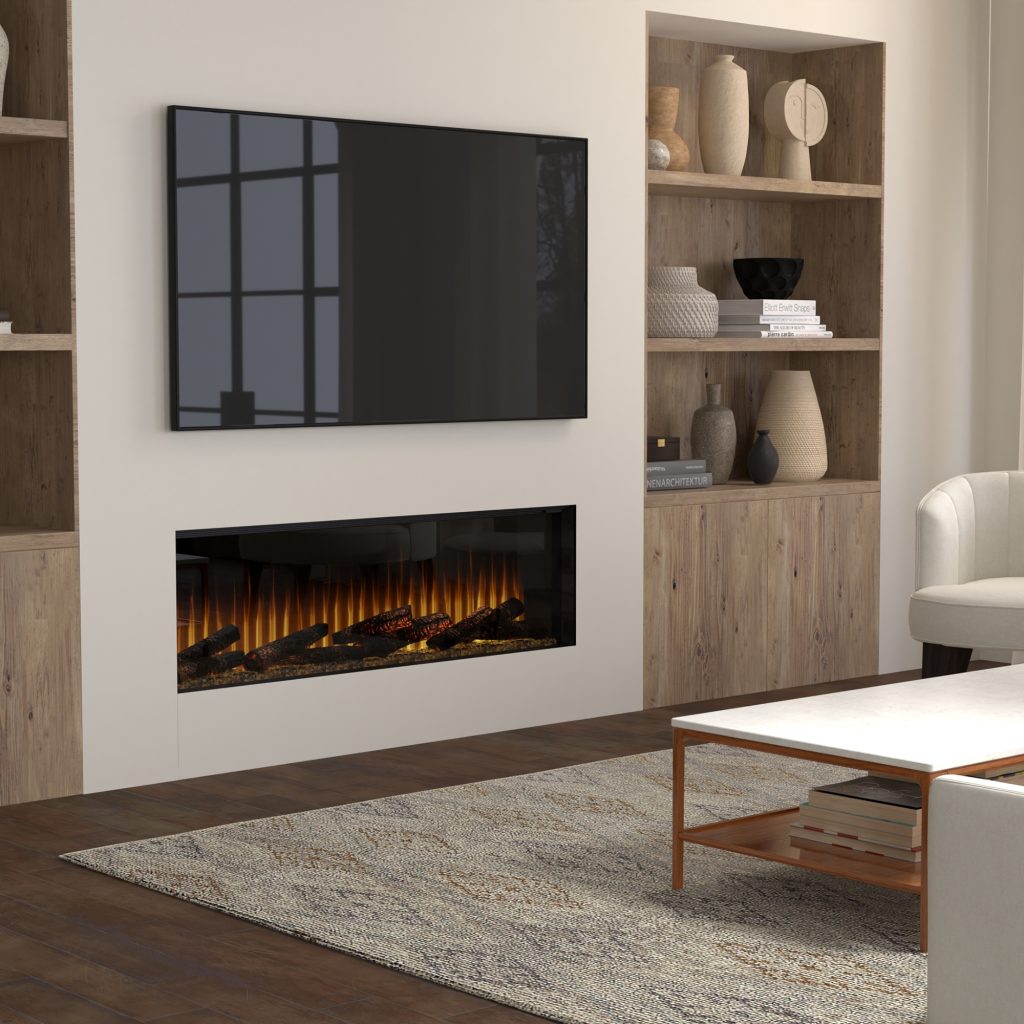
Which shape works best with my TV?
If you’re planning to install a TV above the fireplace, then the fireplace needs to allow for that. Linear fireplaces generally look better below large TVs, but you can get away with a traditional fireplace shape below a small TV. That’s because the fireplace should be wider than the TV, in order for the wall to look balanced. Linear fireplaces also allow for the bottom of the TV to be lower than it would be above a traditional fireplace. This makes for more comfortable viewing from a seated position.
What size of built-in electric fireplace do I need?
The size of your fireplace needs to be in proportion with the rest of the room. It is usually a focal point, so it needs to hold its own with the other elements in the room. It is not uncommon to see fireplaces that are much too small for the space they are in. Rarely have we seen a fireplace that is too big for the room. A common reason for going too small is that the fireplace has been relegated to a small wall within the larger room. Our advice is to find a wall that fits the size of fireplace you need.
When placing a fireplace below the TV, we have a handy reference chart to get the fireplace size right.
Fireplace Sizes to Match Your TV Size
| 55" TV | 50" - 60" fireplace |
| 65" TV | 60" - 74" fireplace |
| 75" TV | 74" - 88" fireplace |
| 85" TV | 88" - 100" fireplace |
What depth should my built-in fireplace be?
Built-in electric fireplaces range in depth from 4-inches to 22-inches, in both linear and traditional styles. Generally speaking, the deeper the fireplace, the more realistic it will look, so we recommend that you choose the deepest electric fireplace that will fit into the space you have.

Video, Water Vapour, or LED – Which built-in electric fireplaces look best?
When it comes to flame quality, beauty is in the eye of the beholder. Luckily, there are lots of options for built-in fireplaces.
- Video flames – LCD flames capture the movement, sparks and sounds of real fire. The quality of the flame effects depends on the projection technology, and varies from brand to brand.
- Water Vapour flames – Ultrasonic technology turns tap water into a fine mist, which looks like live flames when hit with warm lighting. A water connection may be required, which could limit placement in your room. They also require more depth than regular LED fireplaces.
- LED flames – The majority of electric fireplaces fall into this category. Coloured light is reflected through a flicker rod and possibly a stencil, in order to create flame shapes on the back panel of the fireplace. The most realistic of these have a reflective or mirrored back panel, so the flames appear to be coming from the center of a ‘burner’. This category has the most options for size, depth and price.
Built-in electric fireplaces that are see-through or have multi-sided glass
Open floor plans call for fireplaces that don’t block the view. For divider walls, there are see-through electric fireplaces with both LED and water vapour flames. If you need a fireplace at the end of a wall, you can select a multi-sided model that will allow you to have the side glass exposed as you turn the corner. A fireplace with 3-sided glass is a great option between two windows. All of these electric fireplaces are framed in.
What are the electrical requirements for a built-in electric fireplace?
All electric fireplaces may be connected to 120 volts, the regular electrical current that you have in your outlets at home. With a 120-volt connection, either plugged in or hardwired, you can expect a heat output that will warm up about 400 square feet. There are also some built-in electric fireplaces that may be connected to 240 volts, which will boost your heat output to warm up to about 800 square feet. A fireplace with a 240-volt connection will always be hardwired. In every case, electric fireplace manufacturers recommend that the fireplace be connected with a dedicated circuit and have its own circuit breaker on your electrical panel. Without a dedicated circuit, you run the risk of the fireplace heater tripping the circuit breaker. Of course, you can operate the flames without the heater on any electric fireplace, but if you plan to use the heater on occasion, you need to adhere to the recommended wiring.
Summary: Built-in Electric Fireplaces
Here are our top tips to help you narrow down your options for a built-in electric fireplace:
- Built-in electric fireplaces either slide in to a finished opening or are framed in when the wall is being built.
- Built-in electric fireplaces come in 2 shapes: linear or traditional.
- Depths for built-in electric fireplaces range from 4-inches to 22-inches.
- Built-in electric fireplaces are available with flames that are created with video, water vapour or LED lights.
- Built-in electric fireplaces may be single-sided or multi-sided, and some are see-through.
- Built-in electric fireplaces are available to connect to either 120 volts or 240 volts.