


Fifteen ways to turn the wall behind your electric fireplace into the best-looking feature in the room, with the materials, colours and sizing that actually work in Canadian homes.
The fireplace is where everyone looks first. When the wall around it is flat drywall, that attention has nowhere to go. Give the same wall stone, wood, tile or a moody coat of paint and the whole room reorganizes itself around it. That is the idea behind a fireplace accent wall, and an electric firebox is the easiest way to build one because it does not need a chimney, a gas line or a vent through the roof.
Below are fifteen looks that suit real living rooms here, from downtown Toronto condos to open-concept builds in Vaughan and cottages up north. You will also find a materials comparison, colour guidance, sizing and wiring notes, and a long FAQ so you can plan the wall properly before you buy anything.
What is a fireplace accent wall?
A fireplace accent wall is a single wall, usually the one holding the fireplace, finished in a material or colour that contrasts with the rest of the room. Common finishes include stone veneer, brick, wood slats, tile, plaster and dark paint. The fireplace becomes the focal point, and the wall frames it from floor to ceiling or somewhere in between.
Why an electric fireplace makes the accent wall easy
Wood and gas fireplaces come with clearances, venting and combustion that dictate what you can put around them. An electric fireplace removes most of that. There is no flue, no fresh-air intake and no open flame, so you have real freedom with the surround. You can run cladding straight up to the firebox, mount a television above it, and put one in a condo where a real flame would never be allowed.
There are two ways the firebox meets the wall. A recessed unit sits inside the wall cavity so the glass is flush with the cladding, which gives that clean built-in look most of these ideas rely on. A wall-mounted unit hangs on the surface like a piece of art, which is the renter-friendly and condo-friendly option. Our linear in-wall fireplaces handle the first job and the wall-mounted models handle the second. If you are weighing the two, our guide to recessed electric fireplaces walks through what each involves.
15 electric fireplace accent wall ideas
1. Floor-to-ceiling large-format stone
Running large panels of stone from the floor to the ceiling is the most dramatic version of the accent wall, and it is what you see in most 2026 design galleries. Large-format porcelain and natural stone panels have very few seams, so the wall reads as one clean surface with the flame floating in the middle. It suits tall great-room walls and open-concept living rooms where the fireplace is visible from the kitchen. Browse our natural stone veneers to see the tones that work with a linear firebox.
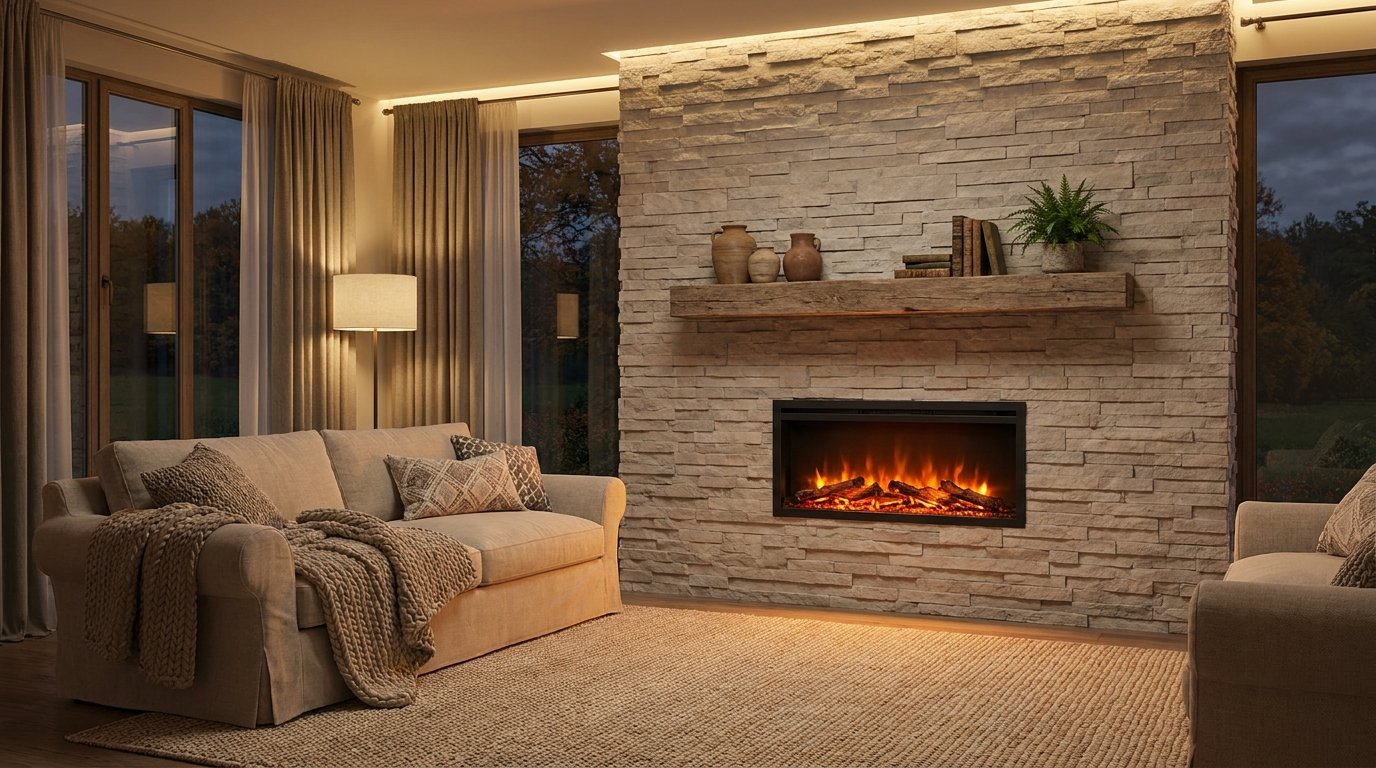
2. Stacked stone and ledgestone
Stacked stone brings texture and shadow. In soft beiges and greys it feels current and calm, and in charcoal it turns moody and modern. Ledgestone panels install in courses and forgive a slightly imperfect wall, which makes them a good choice for a weekend upgrade over an existing surround. If you are refacing an old fireplace, our guide to upgrading a fireplace with stone facing covers how the panels go on.
3. Brick veneer, painted or raw
Brick reads warm and a little bit heritage, which is why it works so well in older Toronto and Hamilton homes. Classic red brick leans traditional, whitewash and German smear lean farmhouse, and a solid painted brick in a deep colour leans modern. Thin brick veneers give you the texture without the weight or the mason, so they sit happily on a standard framed wall.
4. Vertical fluted wood slats
Fluted and slatted wood is the look of the moment. The vertical lines draw the eye up, make a low ceiling feel taller, and add warmth that stone alone can miss. In walnut it feels rich and contemporary, in white oak it feels Scandinavian and light. Keep the slats a safe distance from the firebox opening and use a linear unit with front-facing heat so warm air is not blowing straight into the wood. Our wood wall planks are made for this kind of feature.
5. Shiplap for coastal and farmhouse rooms
Horizontal shiplap is the friendly, budget-aware cousin of the slat wall. Painted crisp white it gives a coastal or modern-farmhouse feel, and stained it turns cabin-cozy. Shiplap pairs beautifully with a simple wood mantel and a wall-mounted firebox, and it is forgiving for a confident DIYer. It is a natural fit for the styling ideas in our living room electric fireplace design ideas.
6. Reclaimed and character wood planks
Where fluted slats feel polished, reclaimed planks feel lived-in. Mixed tones, saw marks and knots give a wall history, which is lovely in a cottage or a rustic loft. Because the material is combustible, this look leans toward a wall-mounted or well-recessed linear unit with clear space around the opening rather than planks butting up to hot glass.
7. Large-format porcelain tile
Porcelain slabs that mimic marble, concrete or travertine give you the luxury of stone with easy maintenance and a lower price. Big tiles mean fewer grout lines and a smoother, more modern surface. They are also very stable near the gentle warmth of an electric firebox. Our stone tiles and panels cover the marble-look and concrete-look options people ask for most.
8. Herringbone tile
Lay a simple tile in a herringbone pattern and an ordinary material turns into a talking point. Herringbone adds movement without colour, so it works when you want interest but the rest of the room is already busy. It is a strong pick for a narrower fireplace wall where a full stone treatment would feel heavy.
9. Zellige and handmade tile
Handmade zellige tile has a slightly uneven, glossy face that catches the flame’s glow and never looks flat. In warm terracotta or deep green it brings personality; in soft white it stays quiet and textural. This is a designer favourite for people who want the wall to feel crafted rather than mass-produced.
10. Moody dark paint or limewash
The lowest-cost idea on this list is also one of the most effective. A deep charcoal, forest green or near-black on the fireplace wall makes the flame pop and instantly adds drama. Limewash takes it further with a soft, cloudy depth that flat paint cannot match. A dark wall also flatters a black firebox surround, an idea we explored in our post on using ebony tones in fireplace design.
11. Plaster and microcement
Venetian plaster and microcement give a smooth, hand-troweled surface with subtle movement and no grout lines at all. The look is warm, minimal and very European, and it suits a floating linear fireplace where you want the wall itself to be the texture. It is a wet trade, so this one is usually a job for a plasterer rather than a weekend project.
12. Metal and leather panels
For a high-end, tactile wall, panels in brushed metal or stitched leather add a layer you rarely see. They work best as an inset behind a linear firebox rather than the entire wall, framing the flame like artwork. Our metal and leather wall panels are the specialty finish for a statement room.
13. A media wall with the TV above
The most requested version of this project is the media wall, where a wide linear fireplace sits below a mounted television, both set into the same clad surface. Done well it hides the wiring, balances the proportions and gives you two focal points that share one wall. A few details matter for heat and viewing height, which we cover below and in our design tips for a fireplace wall with a TV above.
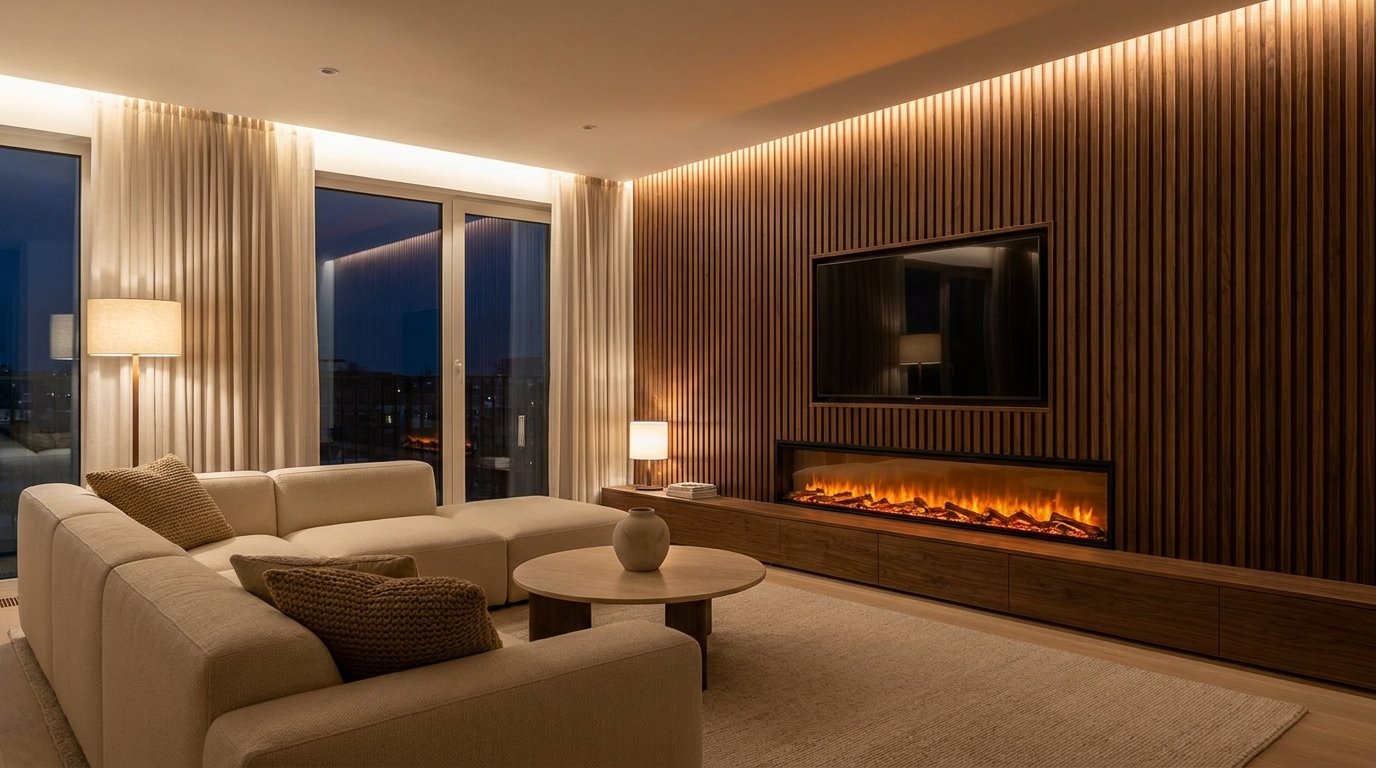
14. A full-height niche with floating shelves
Frame the fireplace with a recessed niche and add floating shelves or integrated lighting on either side. This is the built-in cabinetry look, and it gives you storage and display without breaking the clean line of the accent wall. Pair it with a slim floating mantel for a warm horizontal shelf. If a mantel is part of your plan, see our guide to designing an electric fireplace with a mantel, and browse our custom mantel packages.
15. A see-through fireplace as a room divider
In an open floor plan, a two-sided or see-through firebox turns the accent wall into a divider you can see through, so the flame is shared between the living room and the dining area or hallway. It is a striking way to define space without closing it in. Explore the 2- and 3-sided fireplaces and the see-through models to see how the glass configurations differ.
Accent wall materials compared
| Material | Look | Relative cost | Best for | Effort |
|---|---|---|---|---|
| Natural stone veneer | Textured, organic, timeless | Higher | Floor-to-ceiling statement walls | Pro install |
| Stacked stone panels | Rugged, layered shadow lines | Medium | Refacing an existing surround | DIY-friendly |
| Brick veneer | Warm, heritage, characterful | Medium | Farmhouse and traditional rooms | DIY-friendly |
| Fluted wood slats | Modern, vertical, warm | Medium | Contemporary living rooms | Moderate |
| Shiplap | Coastal, farmhouse, clean | Lower | Budget-aware refreshes | DIY-friendly |
| Large-format porcelain | Sleek, few seams, marble-look | Higher | Minimal, modern feature walls | Pro install |
| Herringbone or zellige tile | Pattern and craft | Medium | Narrow walls that need interest | Moderate |
| Paint or limewash | Moody, dramatic, simple | Lowest | Fast, low-commitment updates | DIY-friendly |
| Plaster or microcement | Smooth, hand-troweled | Higher | Minimalist, European looks | Pro install |
Cost and effort vary a lot by product, wall size and whether you hire a trade, so treat this as a starting point rather than a quote. For a full walkthrough of surround materials, our overview of fireplace surrounds and wall finishes shows what we stock and ship across Canada.
Choosing a colour for your fireplace accent wall
A good accent colour for a fireplace wall is one that clearly contrasts with the surrounding walls while still living inside the room’s palette. Deep charcoal, warm greige, forest green and soft black are the reliable performers because they make the flame stand out and pair with almost any furniture. If your main walls are light, going darker on the fireplace wall gives the strongest effect.
On the question of lighter or darker, a fireplace wall usually looks best a shade or two different from the rest of the room rather than matching it. Darker draws the eye in and feels cozy, which suits winter living rooms. Lighter or textured-but-tonal keeps things calm and works when the fireplace itself, or a mounted TV, is already doing the visual work. For 2026, the trend is warmth and texture: earthy neutrals, tonal stone, wood and near-black accents rather than the cool greys of a few years ago.
Fitting the electric fireplace to the wall
The wall finish is the fun part, but the firebox has to fit the wall before any cladding goes up. Three things decide that: size, how it recesses, and how it is powered.
For size, a common designer guideline is that the fireplace should be noticeably wider than any TV above it, and centred on the wall or the main seating area. Our fireplaces sorted by size make it easy to match the opening to your wall, and the fireplace quiz narrows the field in a couple of minutes if you would rather answer a few questions.
For power, most plug-in electric fireplaces run on a standard 120-volt outlet, while many larger built-in models can be hardwired, and some offer a 240-volt option for maximum heat output. The table below sums up the trade-off.
| 120-volt plug-in | 240-volt hardwired | |
|---|---|---|
| Install | Plugs into a standard outlet | Wired by a licensed electrician |
| Heat | Supplemental warmth for a typical room | Higher output for larger spaces |
| Best for | Condos, renters, easy retrofits | New builds and big great rooms |
| Concealed wiring | Add an outlet inside the cavity for a clean look | Wiring runs inside the wall by design |
Whichever you choose, a few safety basics apply. Manufacturers specify minimum clearances from the firebox to combustible materials such as mantels and cladding, and those instructions come first on any install. General home guidance from the Electrical Safety Authority’s indoor electrical safety page is to keep heaters away from combustibles, plug them directly into a wall outlet rather than an extension cord, and hire a licensed electrical contractor for any permanent wiring. If you want the outlet hidden inside the wall, plan that before the cladding goes on. For the framing and cavity side of things, our built-in electric fireplace planning guide is the place to start.
Mounting a TV above the fireplace
Putting a television above the firebox is popular and perfectly doable with electric, because the heat is gentle and usually vents from the front or top rather than straight up the wall. Two things keep it comfortable. First, leave enough vertical space between the top of the fireplace and the bottom of the TV, following the fireplace maker’s guidance, and route the heat away from the screen. Second, watch the mounting height so you are not craning your neck; a lower linear firebox helps here because it lets the TV sit lower than a tall traditional unit would. Our article on wall designs that beat a TV stand with a fireplace shows the layouts that work.
Are accent walls out of style in 2026?
No. What has changed is the execution. The single wall of bold contrast paint has given way to full-height texture: stone, wood, plaster and tile that wrap the fireplace and often the whole wall. The accent is still there, it is just built from material and shadow rather than one loud colour. A fireplace accent wall done in natural texture is very much in step with where interiors are heading.
Planning your accent wall: a Canadian buyer’s checklist
- Measure the wall height and width, and note where studs, the cavity depth and any windows fall.
- Pick the firebox first. Its size and whether it recesses drives everything about the cladding.
- Decide recessed or wall-mounted based on your wall depth and whether you can open it up.
- Choose one hero material so the wall has a clear story, then keep the mantel and shelving simple.
- Plan the power and any concealed outlet before finishing, and book an electrician if you are hardwiring.
- Confirm the manufacturer’s clearances to combustibles for your mantel and surround.
- Order a little extra cladding for cuts and waste, especially with patterned tile.
Cost usually comes down to four drivers: the firebox itself, the material you clad the wall in, the size of the wall, and whether a trade does the framing, electrical and finishing. A painted wall with a wall-mounted unit is the low end; a floor-to-ceiling natural stone wall with a recessed linear firebox and a mounted TV is the high end. Most projects land somewhere in between.
See it in person in Vaughan
Pictures only go so far with texture and flame. If you are in the Greater Toronto Area, it is worth seeing the fireboxes lit and the surround materials up close before you commit. You can visit our Vaughan showroom at 8301 Jane Street, talk through your wall with someone who does this every day, and take the guesswork out of sizing. Prefer to plan from home anywhere in Canada? Get in touch with our team or start with the fireplace quiz and we will help you match a firebox to the accent wall you have in mind.
Frequently asked questions
What is a fireplace accent wall?
It is the wall holding the fireplace, finished in a material or colour that stands apart from the rest of the room. Stone, brick, wood, tile, plaster or dark paint are the usual choices. The goal is to make the fireplace the clear focal point and give the room a sense of anchor.
Do electric fireplaces work well for an accent wall?
They are the easiest option. With no chimney, gas line or open flame, you can clad the wall freely, recess the unit for a flush built-in look, and install in condos where combustion fireplaces are not allowed. That freedom is why most modern fireplace accent walls use an electric firebox.
What is a good accent colour for a fireplace wall?
Colours that contrast with the surrounding walls but stay in the room’s palette work best. Charcoal, warm greige, forest green and soft black are dependable because they make the flame stand out and pair with most furniture. Darker shades give the strongest effect when your main walls are light.
Should the fireplace wall be lighter or darker than the rest of the room?
Usually a shade or two different rather than matching. Darker pulls the eye in and feels cozy, which suits Canadian winters. Lighter or tonal-but-textured keeps the room calm and works when the firebox or a mounted TV already provides the focal point. Either way, contrast is what makes it read as an accent.
Are accent walls out of style in 2026?
No, though the style has shifted. Single walls of bold paint have given way to full-height texture in stone, wood, tile and plaster. The accent now comes from material and shadow rather than one loud colour, and a textured fireplace wall is firmly on trend.
What are the fireplace design trends for 2026?
Warmth and texture lead the way: floor-to-ceiling stone, fluted and slatted wood, large-format porcelain, plaster finishes and near-black accents. Linear electric fireboxes and clean media walls with a hidden TV are the popular formats, and earthy neutrals have replaced the cool greys of past years.
How do I design a fireplace accent wall?
Start with the firebox size and how it recesses, then choose one hero material for the wall. Plan the power and any hidden outlet before cladding, confirm the maker’s clearances, and keep the mantel and shelving simple so the material and flame stay the stars. Measure carefully and order extra material for cuts.
Can I put a TV above an electric fireplace on the accent wall?
Yes. Electric fireplaces give off gentle heat, usually vented from the front or top, which makes a mounted TV practical. Leave the clearance the manufacturer specifies between the firebox and the screen, route heat away from the TV, and mount at a comfortable viewing height.
How high should the fireplace and TV sit?
Center the fireplace on the wall or seating area, and mount the TV so its center is near eye level from your sofa. A low, wide linear firebox helps, since it lets the TV drop to a comfortable height instead of sitting too high above a tall unit. Always follow the fireplace maker’s spacing.
Do I need a special wall to recess an electric fireplace?
You need enough cavity depth for the model you choose. Some slim units fit a standard framed wall, while deeper ones need a built-out or thicker wall. Check the unit’s required depth against your wall, or filter our range by wall depth so you only see fireboxes that fit.
Do electric fireplaces need a dedicated circuit?
Many plug-in models run on a standard 120-volt outlet, but because the heater draws real current it is best not to share that circuit with other heavy loads. Larger or hardwired units, including 240-volt models, should be wired by a licensed electrician on an appropriate circuit. Follow the model’s electrical requirements.
How much does a fireplace accent wall cost in Canada?
It depends on the firebox, the cladding material, the wall size and whether trades do the work. A painted wall with a wall-mounted unit is the low end, while a floor-to-ceiling stone wall with a recessed linear firebox and a mounted TV is the high end. Most homeowners land in between.
What is the best material for a fireplace accent wall?
There is no single best; it depends on your style and budget. Natural stone and large-format porcelain give a high-end modern look, brick and wood bring warmth, and paint or limewash deliver drama for the least money. Match the material to the room and to how much work you want to take on.
Can I build a floor-to-ceiling accent wall in a condo?
Often yes, with lightweight veneers or a wall-mounted firebox that avoids opening up the wall. Electric is ideal for condos because there is no venting. Check your building’s rules and, for lower-effort options, see our picks for small electric fireplaces for condos and cozy nooks.
Is stone veneer or tile better around an electric fireplace?
Both perform well next to the gentle warmth of an electric firebox. Stone veneer gives depth and a rugged, organic texture, while large-format tile gives a smoother, more continuous modern surface that is easy to clean. Choose based on the look you want and how many grout lines you are willing to live with.
Can an electric fireplace accent wall heat the room?
Yes, most models include a heater that provides supplemental warmth for a typical living room, and larger or 240-volt units heat bigger spaces. The flame can also run on its own without heat, so the wall stays a year-round feature even in summer.
How far should combustible materials be from the firebox?
Follow the clearances in the fireplace’s installation manual, which specify minimum distances from the opening to mantels, cladding and other combustibles. General electrical-safety guidance also recommends keeping heaters at least about a metre from combustible items. When in doubt, ask us or your installer before finishing the wall.