


Room-by-room guidance on mounting height, TV pairing, and installation
If you’re standing in your living room trying to picture where your new electric fireplace should go, you’re not alone. “How high should I mount my electric fireplace?” is one of the most common questions we hear in our GTA showroom, right after “which one should I choose?”
The good news is there’s a clear, practical answer, with just enough flexibility to suit your space, your furniture and your style.
The Golden Rule
Before we get into specific numbers, there’s one principle that guides everything else: a fireplace almost always looks better when you’re looking slightly down into the flames, not up at them. This holds true whether you’re sitting on a sofa, relaxing in a chair, or lying in bed.
Seated eye level for most adults is roughly 40 to 42 inches from the floor. That’s your anchor point for almost every decision that follows.
Fireplace Shape Changes Everything
The shape of your unit is the biggest factor in finding the right height. Here’s how to think about the two most common styles.
Linear (wide-format) fireplaces Linear fireplaces are our best-selling style. These are the units that are much wider than they are tall, with a long, lean profile. They look best at least 12 inches off the floor, and how much higher you go depends on a few things. If you’ll be seated when viewing the fireplace, you want it low enough to look down at the flames from your sofa, but not so low that it disappears behind a coffee table or footstool. Generally, this puts the bottom of a linear unit 12 to 30 inches off the floor. For dining areas, we suggest raising it to approximately 36 inches so the chair backs don’t hide the flames.
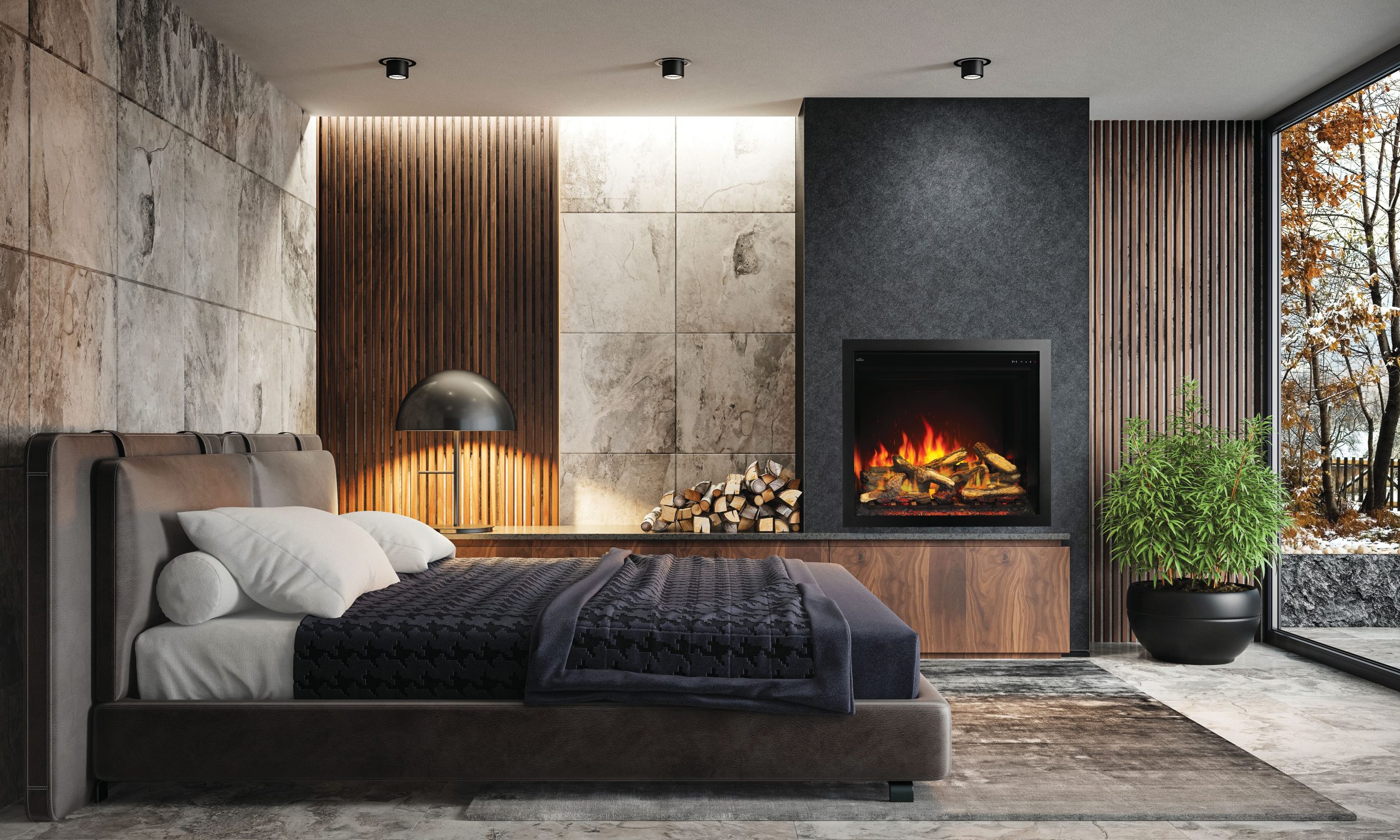
Traditional (square or portrait-shaped) fireplaces A traditional fireplace is one that’s closer to a square shape, similar in proportion to a classic wood-burning hearth. These units are often placed close to floor level, but they don’t have to be. Raising them 6 to 12 inches off the floor is perfectly acceptable. In bedrooms, we suggest going higher still, so the flames are visible from the bed. That usually means 24 to 36 inches off the floor. We’ve also seen traditional fireplaces placed 36 to 42 inches off the floor in historic kitchens, and in that context it looks completely natural. These are guidelines, not rules. As long as you’re looking slightly down into the flames from wherever you’ll be sitting or lying, you’re in good shape.
Quick-Reference Height Guide
Setting
Living Room, linear
Living Room, traditional
Bedroom
Dining Room, linear
Below a TV
Low-ceiling Rooms
Bottom of unit from floor
12 to 30 inches (30 to 76 cm)
6 to 12 inches (15 to 30 cm)
24 to 36 inches (60 to 91 cm)
~ 36 inches (91 cm)
Work down from TV position (see below)
Lower third of wall height
Room-by-Room
Living room Start with the 40 to 42 inch principle and work backward from your sofa. For a linear unit, 12 to 18 inches off the floor creates a grounded, modern look. Raise it to 24 to 30 inches if you’d prefer the flames to fall more directly in your sightline. Traditional-style units generally sit 6 to 12 inches from the floor, giving them the feel of a built-in hearth.
Bedroom Here you’re typically viewing the fireplace from a lying-down or semi-reclined position, so the flames need to be higher than in a living room. Mount the bottom of a bedroom fireplace 24 to 36 inches off the floor. Water vapour fireplaces are especially popular in this setting, a realistic flame effect with no heat output, so they’re safe to run overnight.
Dining room The key consideration is chair backs. High-back chairs can partially block a fireplace that’s mounted too low. For a linear unit in a dining room, mount the bottom approximately 36 inches from the floor so the flames are visible above seated guests. One other tip: centre the fireplace behind the table itself, not the wall as a whole.
Basements and low-ceiling rooms All of the above guidelines still apply, with a few cautions. Try not to cut the wall in half with the fireplace. Keep it in the lower third of the total wall height, and think about what you might want to place above it. You need to make sure there’s enough space between the top of the fireplace and the ceiling once it’s mounted.
Mounting Below a TV: Do It in This Order
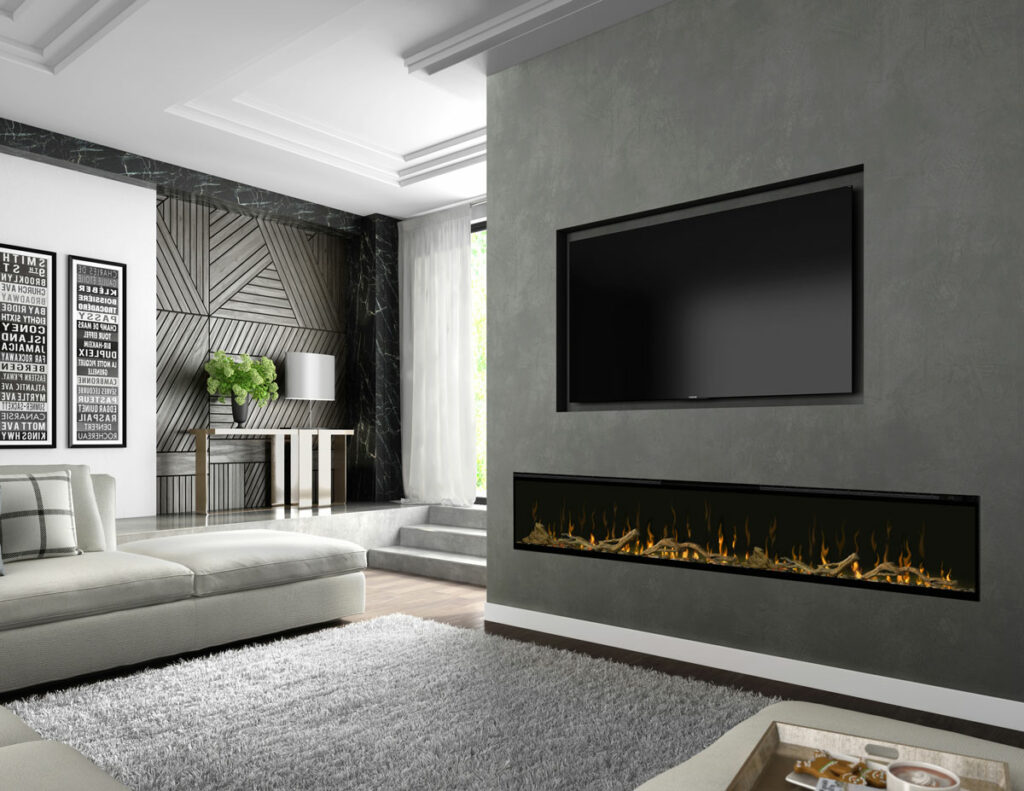
Pairing a TV and fireplace on the same wall is one of the most popular setups we see. The order of operations matters.
- Position the TV first. For comfortable seated viewing, the bottom of the TV should be no higher than 42 to 43 inches from the floor.
- Work down from there. The space between the floor and the bottom of the TV is your fireplace zone. Many people centre a linear fireplace in this space. If your TV bottom sits at 42 inches, the fireplace bottom often lands around 12 to 15 inches from the floor. A traditional-shaped fireplace will take up more of that vertical space, so larger units will end up sitting closer to the floor.
- Account for a mantel shelf if you want one. A floating shelf between the TV and fireplace is a nice detail, but it takes up vertical space and will push the fireplace lower. Factor in 4 to 6 inches for a typical shelf.
One note worth flagging: these guidelines apply to electric fireplaces. If you’re mounting a TV above a gas fireplace, check the manufacturer’s clearance specifications. The more intense heat output typically means the TV needs to sit considerably higher.
Watch our video on fireplaces & TVs
A Few Installation Notes
- Mount into wall studs wherever possible. Electric fireplaces typically weigh 50 to 200 pounds and wall anchors alone aren’t enough when hanging a fireplace on the wall.
- Plan your wiring location before finalizing the height. If it’s a plug-in fireplace, the outlet should sit inside the wall, off to one side, or on the wall directly beneath it. You can also direct-wire the fireplace so that no cords are visible. Never use an extension cord to power an electric fireplace.
- For recessed in-wall installations, check local building codes before cutting into the wall. Most Canadian municipalities require a permit for structural changes.
- If you’re renting, always get written approval from your landlord before installation. A surface-mounted unit is the most renter-friendly option, as it can be removed and the wall patched when you move out.
Still Not Sure?
These guidelines cover the vast majority of situations, but every home is a little different. If you’re working on a specific project and want a second opinion, we’re happy to help. Visit our GTA showroom to see fireplaces mounted at a range of heights across different room settings. We’ve specifically designed several of our displays to illustrate exactly how mounting height changes the look and feel of a space. You can also browse our full collection online and reach out any time with your measurements and room photos.